How to Choose a Security Guard Company in Atlanta

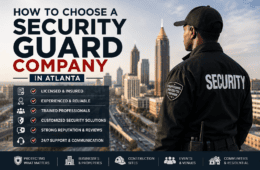
Before hiring a security guard company in Atlanta, confirm that it’s licensed by the Georgia Board of Private Detective and Security Agencies, carries general liability insurance, trains and directly supervises its officers, and can explain — in plain terms — how its coverage plan fits your specific property. Below is what to check before you sign a contract, plus the questions worth asking any company you’re considering.
Confirm the Company Is Licensed and Insured in Georgia
In Georgia, security guard companies and their officers must be licensed through the Georgia Board of Private Detective and Security Agencies. Ask any company you’re vetting for its agency license number and proof of general liability insurance before you sign anything — a legitimate provider will hand this over without hesitation. If a company can’t produce a license number on request, that’s a reason to keep looking.
Ask How Guards Are Trained and Supervised
Licensing covers the minimum legal bar; training and supervision determine how a guard actually performs on your property. Ask what training officers receive beyond the state minimum — site-specific orientation, de-escalation, emergency response — and how the company supervises guards once they’re on post, whether that’s spot checks, patrol logs, or a dedicated field supervisor. A guard standing at your gate is only as reliable as the training and oversight behind them.
Decide Whether You Need Armed or Unarmed Coverage
Most Atlanta properties — offices, apartment communities, retail centers, construction sites — are adequately covered by unarmed security guards trained in access control, patrol, and incident response. Armed security guards typically make more sense for higher-risk environments, such as cash-handling operations, data centers, and industrial facilities with an elevated threat profile. A reputable company should help you determine which level of coverage actually fits your risk, rather than upselling you into armed coverage you don’t need.
Look at Response Times and Local Presence
A security company based in Atlanta with local supervisors can typically respond to on-site issues, last-minute schedule changes, or emergency coverage requests faster than a national chain routing decisions through a call center. Ask how quickly the company can staff an unplanned shift or respond to an on-site incident, and whether coverage is available 24/7 — not just during business hours. If your coverage needs fluctuate, ask whether the company also offers mobile patrol services as a lower-cost option for off-hours coverage.
Understand How Pricing Is Structured
A quote that’s just a single hourly number, with no explanation behind it, is a red flag. Reliable providers price coverage around your property type, hours needed, number of posts, and risk factors — see our full breakdown of what drives security guard pricing in Atlanta for specifics. Be cautious of a bid that’s dramatically lower than every other quote you receive; it usually means lower guard pay, less training, or thinner insurance coverage somewhere in the chain.
Check Reviews and Ask for References
Look for reviews that mention specific, verifiable details — response time, professionalism of officers, how the company handled an incident — rather than generic five-star praise. For an ongoing contract, like an apartment community or commercial property, ask the company for a current client reference in a similar setting you can call directly.
Confirm Coverage Across the Areas You Operate
If you manage multiple properties across Metro Atlanta, confirm the company actually services all of them, rather than covering downtown well and struggling to staff a location in the northern suburbs. See the full list of Metro Atlanta areas we cover.
Questions to Ask Before You Sign
- Are you licensed by the Georgia Board of Private Detective and Security Agencies, and can I see your license number?
- What’s your general liability insurance coverage?
- How are your officers trained, and how often?
- How do you supervise guards once they’re on post?
- Can you staff an unplanned shift or emergency coverage on short notice?
- Do you offer both armed and unarmed coverage, and can you help me determine which I need?
- How is pricing structured, and what factors affect my rate?
- Can I get a reference from a current client with a similar property?
The Bottom Line
The cheapest quote isn’t always the safest choice, and the biggest name isn’t always the most responsive one. A security guard company that’s properly licensed, trains and supervises its officers, and can clearly explain how its coverage fits your property is worth more than a marginally lower hourly rate.
Ready to talk through coverage for your property? Request a quote or call 678-578-8787.
Frequently Asked Questions
Start by confirming the company is licensed by the Georgia Board of Private Detective and Security Agencies and carries liability insurance, then ask how officers are trained and supervised, how pricing is structured, and whether they can provide a reference from a similar property.
Security guard companies operating in Georgia must be licensed through the Georgia Board of Private Detective and Security Agencies, and individual officers must hold the required state registration to work as armed or unarmed guards.
Pricing depends on factors like armed vs. unarmed coverage, hours needed, number of posts, and property risk level. See our detailed pricing guide for a full breakdown of what affects your rate.
Most companies, including Eagle Eye Protection, offer both. Armed guards carry firearms and typically cost more due to additional licensing and training requirements; unarmed guards are the standard choice for most commercial and residential properties.
Not necessarily. A quote that’s significantly lower than competitors’ often reflects lower guard pay, reduced training, or insufficient insurance coverage. Compare licensing, training, supervision, and references, not just the hourly rate.
Many do, including overnight, weekend, and holiday coverage. Ask any company you’re considering about their availability for emergency or after-hours staffing before you sign a contract.