

Armed vs. Unarmed Security Guards in Georgia
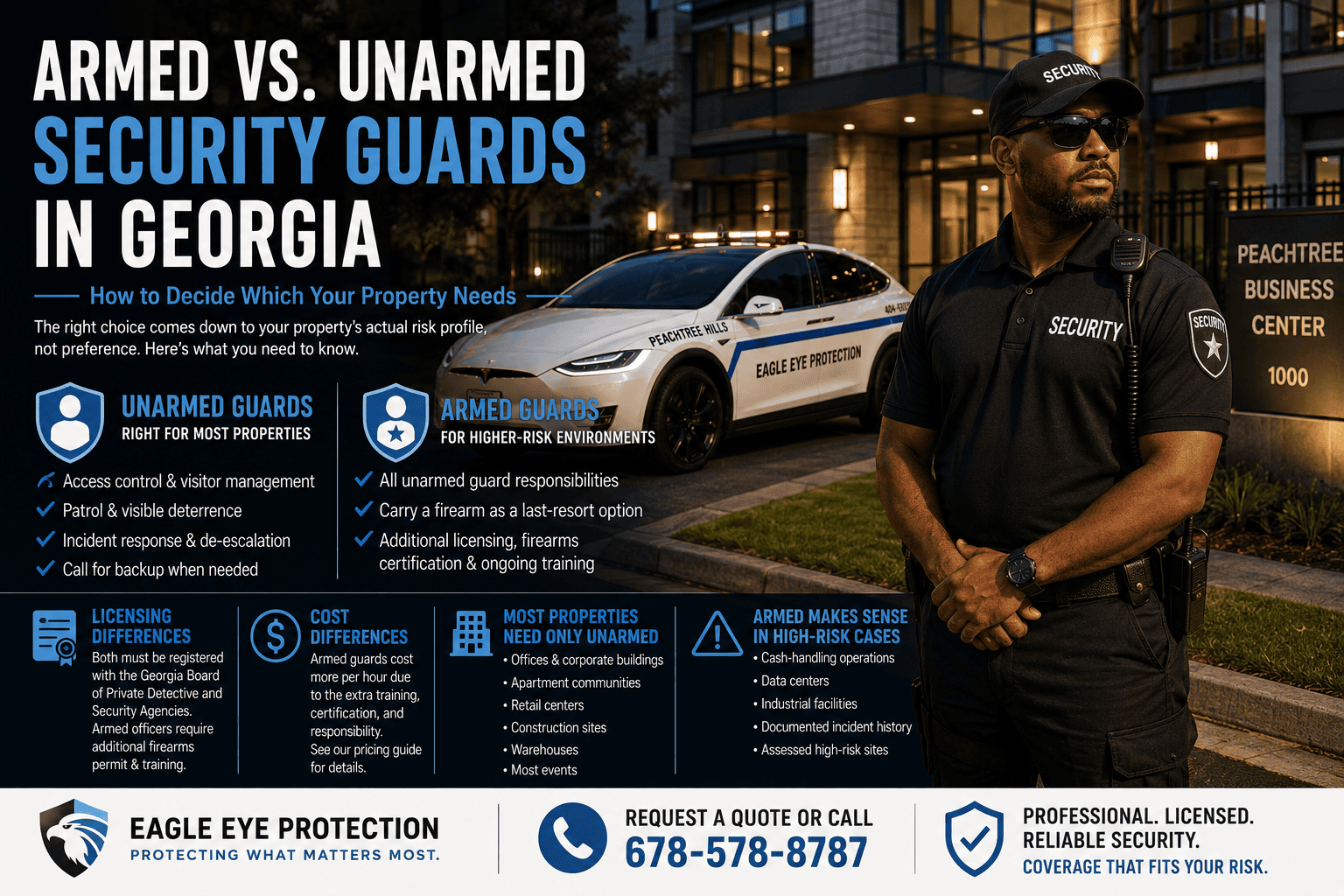
Unarmed security guards are the right choice for the large majority of Atlanta properties — offices, retail, apartment communities, and construction sites — where the goal is visible deterrence, access control, and incident response. Armed security guards make sense for a smaller set of higher-risk environments: cash-handling operations, data centers, industrial facilities, and sites with an elevated, documented threat. The decision comes down to your property’s actual risk profile, not preference.
What Unarmed Security Guards Actually Do
Unarmed security guards handle access control, patrol, visitor management, incident response, and de-escalation. They’re trained to observe, deter, document, and call for backup or law enforcement when a situation escalates beyond what a security presence alone should handle. For most commercial and residential properties, this is the entire job description, and it covers the actual risk the property faces.
What Armed Security Guards Add
Armed security guards do everything an unarmed guard does, plus carry a firearm as a last-resort deterrent and response option. That additional capability comes with additional state licensing, firearms certification, and ongoing training requirements — which is also why armed coverage costs more per hour than unarmed coverage.
Licensing Differences Between Armed and Unarmed Guards in Georgia
In Georgia, both armed and unarmed guards must meet the state’s registration requirements through the Georgia Board of Private Detective and Security Agencies. Armed officers must additionally complete firearms permit requirements and weapons-specific training beyond the unarmed baseline before they can carry on duty.
Properties That Typically Need Only Unarmed Coverage
- Office buildings and corporate campuses
- Apartment and multifamily communities
- Retail centers and shopping plazas
- Construction sites
- Warehouses without high-value or hazardous inventory
- Event security for most private and corporate events
Properties Where Armed Coverage Is Worth Considering
- Cash-handling operations (banks, check-cashing, cash-in-transit)
- Data centers and critical infrastructure
- Industrial facilities with hazardous materials or high-value equipment
- Properties with a documented history of violent incidents
- Sites specifically assessed as high-risk by a security consultant
Cost Differences Between Armed and Unarmed Guards
Armed guards cost more per hour than unarmed guards, reflecting the additional licensing, certification, and ongoing training their role requires. See our pricing guide for the full breakdown of what drives security guard cost in Atlanta.
Common Misconception: Armed Doesn’t Always Mean Safer
A visible, well-trained unarmed guard deters the vast majority of incidents a typical commercial property will ever face — theft, trespassing, disorderly conduct. Adding a firearm to a post that doesn’t need one doesn’t add meaningful protection; it adds cost and, in some settings, can make tenants, customers, or residents uneasy. The right call is based on your documented risk, not on which option sounds more serious.
How to Decide What Your Property Needs
A reputable provider should assess your property’s actual risk — past incidents, property type, cash or asset exposure, foot traffic — and recommend coverage based on that, not upsell you into armed guards by default. If you’re not sure, see our full guide to choosing a security guard company for what to ask.
The Bottom Line
Most Atlanta properties are well served by unarmed coverage. Armed coverage is a tool for a specific, higher-risk category of properties — not a universal upgrade. Request a quote or call 678-578-8787 and we’ll help you determine which coverage actually fits your property’s risk.
Frequently Asked Questions
Armed guards carry a firearm and complete additional state licensing and training beyond the unarmed baseline; unarmed guards handle access control, patrol, and incident response without a weapon.
Yes — armed coverage typically costs more per hour than unarmed coverage due to the additional licensing, certification, and training required.
Armed officers must meet Georgia’s standard security guard registration requirements plus additional firearms permit and weapons training requirements before carrying on duty.
For most office buildings, yes — unarmed guards trained in access control and incident response are the standard, adequate choice.
Yes, coverage can be adjusted as your risk assessment or property needs change.
Some apartment communities do use armed coverage depending on documented risk, though unarmed guards are the more common choice for multifamily properties.